Data Centers and Water Quality, June 18, 2026

By Adam Effler, Executive Director at the Owasco Lake Watershed Management Council

Data centers impact water quality primarily through high-volume consumption, chemical discharge, thermal pollution, and indirect pollution from power generation. These impacts directly affect local watersheds, drinking water supplies, and agricultural resources. Data centers heavily rely on water-intensive evaporative cooling. During this process, they introduce several pollutants into local wastewater systems.  Facilities routinely add biocides (to prevent algae/bacteria), corrosion inhibitors, and anti-scaling agents to their cooling systems. If improperly treated or spilled, these chemicals degrade local surface water quality.  Trace amounts of metals like copper, zinc, and lead can leach into the water as the cooling system’s metal components degrade over time. As water evaporates from open-loop cooling towers, the remaining salts, minerals, and existing contaminants become highly concentrated. Discharging this dense, saline water into nearby rivers or farm fields can harm aquatic ecosystems and contaminate groundwater. Cooling thousands of hot servers means data centers constantly discharge large volumes of heated water back into the environment. This thermal pollution lowers the dissolved oxygen levels in local streams, lakes, or aquifers, which can harm aquatic life and promote harmful algal blooms.

Data centers are massive consumers of electricity, and the power plants supplying this energy frequently rely on water for cooling. Coal and natural gas power plants withdraw billions of gallons of water annually; in the process, they alter water temperatures and return polluted water back to the local watershed, compounding the overall environmental toll.  Many data centers pull freshwater directly from municipal utility lines or underground aquifers. In drought-prone or heavily developed regions, heavy pumping lowers the water table. Lower water tables and reduced streamflow naturally increase the concentration of any existing pollutants in the remaining water.

On June 4, 2026, the New York State Legislature passed the Responsible Data Center Development Act, which includes a one-year moratorium on permits for new large-scale data centers while the state studies their environmental, energy, water, and community impacts. The measure was scaled back from an earlier proposed three-year ban and is intended to give policymakers time to develop regulations for the rapidly growing data center industry, particularly facilities supporting artificial intelligence and cloud computing. The bill also requires an environmental impact report, public hearings for major projects, energy-efficiency standards, and protections for ratepayers and host communities. Supporters argue the pause is necessary because large data centers consume significant amounts of electricity, water, and land, potentially increasing utility costs and environmental pressures. Opponents, including business and technology groups, contend that the moratorium could discourage investment, slow economic development, and weaken New York’s competitiveness in the AI and technology sectors.  As of June 25, 2026, the bill still requires approval from Governor Kathy Hochul to become law.



Moravia Gives Back Day

By Michele Wunderlich, Principal Environmental Planner, Cayuga County Department of Planning & Economic Development

On Monday, May 18, 2026, the Moravia Central School District held its annual Moravia Gives Back Day, a celebration of community service and student involvement. As part of the event, fifteen students and two teachers volunteered at the Fillmore Nature Preserve, where they helped clean up trails. Adam Effler and Jessie Lloyd provided guidance and support to the students as they cleaned the trails. Michele Wunderlich provided information on how to identify the invasive species in the preserve. Thanks to the hard work of these students and staff, the preserve is now a little cleaner—and our students are a little wiser about conservation and community service.

(Cover photo is multiflora rose, an invasive species found at Fillmore Nature Preserve)

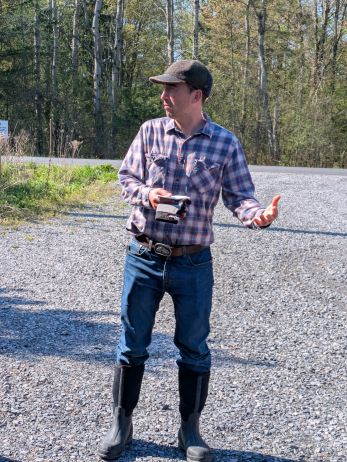
Adam Effler introduces students to Fillmore Nature Preserve

Lake Friendly Living Event: Owasco Watershed Cleanup for Mother Earth

Lake Friendly Living Title Photo

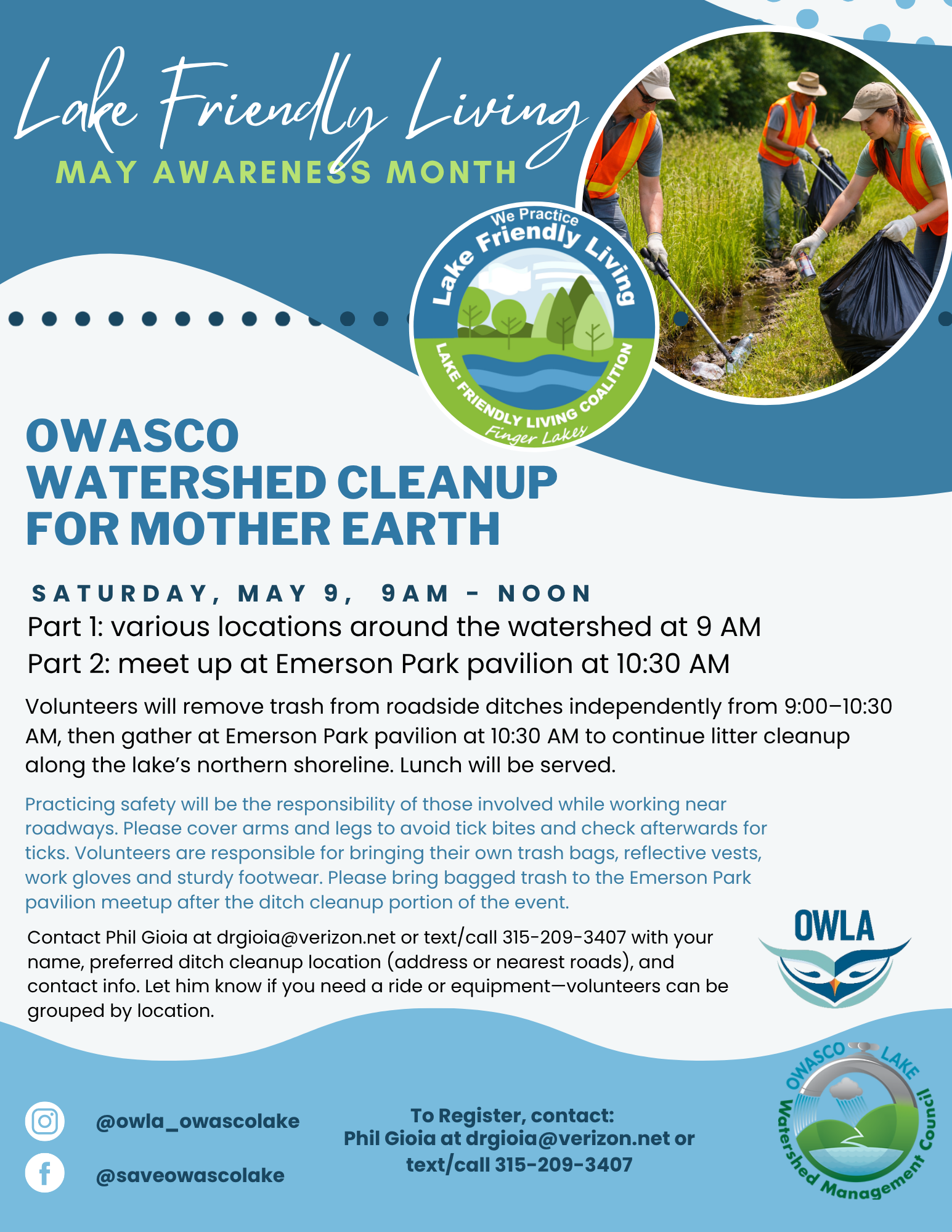
The Owasco Lake Watershed Management Council and the Owasco Watershed Lake Association Partnership is holding a clean up event as part of Lake Friendly Living Awareness Month on Saturday, May 9, 2026 from 9 am to noon. Click on the photo below for more information.

For more Lake Friendly Living Programs, visit www.flrwa.org/lake-friendly-living.

Lake Friendly Living Event Owasco Watershed Cleanup for Mother Earth

Cayuga Lake Protection Plan

Heavy residential use along the densely populated Cayuga Lake shoreline is allowing pollutants and excess nutrients to enter the water, contributing to harmful algal blooms that have increased in frequency in recent years.

To minimize this surge, this project proposes to install a low-pressure sewer system along an approximate nine-mile Cayuga Lake shoreline in the towns of Ledyard and Genoa, creating a new Cayuga County sewer district in the process. Wastewater from homes in the district will be transported to the Village of Aurora’s wastewater treatment plant to be safely treated.
The Cayuga Lake Protection Plan:

  • Protects Cayuga Lake water quality
  • Helps maintain clean, safe water for swimming, fishing, boating, and recreation
  • Retires aging holding tanks and septic systems
  • Offers convenience, eliminating pump-outs, septic maintenance, and emergency repairs
  • Reduces resident costs through substantial state grant funding
  • Safeguards the tourism economy that supports our region
  • Preserves the natural beauty that makes the Finger Lakes unique and special

Public meetings are scheduled for Tuesday, May 5th and Tuesday, June 2nd at 7 p.m. at the Southern Cayuga School Cafeteria, 2384 Route 34B, Aurora.

Eligible property owners can vote on the project Tuesday, June 23rd from 6 am to 9 pm. Town of Ledyard and Genoa polling locations will be announced soon.

For more information, visit their website at https://ccwsa.us/projects/cayuga-lake-protection-plan.

A flyer for this project is available at CCWSA-0001A_Stakeholder_Trifold_Direct_Mailer_P13.

If you have questions, please contact Susan Phillips at sphillips@ccwsa.us .

Cayuga County’s Countywide Brownfield Opportunity Area (BOA) Pre-Planning Inventory and Analysis Project Kick Off Public Meetings

Kari Terwilliger, Director, Cayuga County Department of Planning and Economic Development

The Cayuga County Department of Planning and Economic Development was awarded a grant from the New York State Department of State under Title 11 of the Environmental Protection Fund to conduct the Countywide Brownfield Opportunity Area (BOA) Pre-Planning Inventory and Analysis Project.

As part of this effort, the Cayuga County Department of Planning & Economic Development invites community members to participate in a Project Kickoff event. This meeting will introduce residents and stakeholders to the Countywide BOA Pre-Planning Inventory and Analysis planning initiative by providing an overview of the project scope and key topics to be addressed. Additionally, they are seeking public input to help identify and prioritize sites around the county that are potentially contaminated and/or underutilized. A public survey will be released immediately following the meeting to gather additional public input and comments. This project represents a vital step forward in identifying priority sites that may be potentially contaminated and/or underutilized across the county for future cleanup and redevelopment.

Both meetings will follow the same format and cover the same materials, so attendees are encouraged to come to the session that is the most convenient for them. Each meeting will begin with a brief presentation and then continue open house-style with interactive displays. The meetings are scheduled for the following dates & locations:

Southern Location
Wednesday, April 22nd from 6:00 PM – 8:00 PM
Locke Volunteer Fire Department; 1060 State Route 38, Locke, New York 13092

Central Location
Thursday, April 23rd from 6:00 PM – 8:00 PM
Cayuga-Onondaga BOCES; 1879 W. Genesee Street Road, Auburn, New York 13021

Anyone with questions please send an email to planning@cayugacounty.gov or call (315) 253-1276.

Christmas Tree Recycling – Cayuga County Trade-A-Tree Program

Cayuga Recycles, a program of the Cayuga County Planning Department, in conjunction with the Cayuga County Soil and Water Conservation District and Cornell Cooperative Extension of Cayuga County, is sponsoring the annual “Trade-A-Tree” program in Cayuga County. Bring in your “used” (real) Christmas tree after the holidays, and we will give you a certificate for a tree seedling to be picked up in the spring! Old trees will be chipped into mulch to be used on county projects, rather than taking up space in landfills. A White Spruce seedling will be given out to anyone who redeems their certificate on May 8, 2026, at the Annual Conservation District Spring Tree & Shrub Sale.

Trees must be free of decorations, tinsel, wraps or any other foreign objects. Trees will be accepted at the Natural Resource Center, 7413 County House Road, Auburn, NY during the following hours:

December 26, 2025, from 8 AM – 3:30 PM.
December 29-30, 2025, from 8 AM – 3:30 PM.
December 31, 2025, from 8 AM – 12 PM.
January 2, 2026, from 8 AM – 3:30 PM.
January 5-9, 2026, from 8 AM – 3:30 PM.
January 12-16, 2026, from 8 AM – 3:30 PM.

For more information, please visit our website at https://www.cayugacounty.gov/1820/Trade-a-Tree-Program or call the Cayuga County Soil and Water Conservation District at 315-252-4171 ext. 4, or stop by their office located on County House Road in Sennett. They are available Monday – Friday from 7:30 AM – 4:00 PM.